How Much Does It Cost to Charge an Electric Car?
Charging an electric car at home usually costs a fraction of a tank of petrol. Charging it at a fast public charger can cost two or three times more than at home. So the honest answer to “how much does it cost to charge an electric car?” is: it depends mostly on where you plug in.
This guide shows the simple formula, what one charge costs for a scooter, a small car and a family car in Pakistan and the US, what charging adds to your monthly bill, and how Pakistan’s electricity slabs can quietly raise the price of every unit.
Short answer: Cost of a charge = kWh you add ÷ 0.9 (for charging losses) × price per unit. Adding 42 kWh to a 60 kWh battery (10% to 80%) costs about Rs 2,100 at home in Pakistan at Rs 45 a unit, Rs 5,133 at a Rs 110 public charger and Rs 7,000 at a Rs 150 fast charger. In the US it costs about $8.40 at home and $24.73 at an average fast charger.
How to work out the cost to charge an electric car
- Find the energy you will add. Battery size in kWh × the share you are filling. A 60 kWh battery from 10% to 80% takes 60 × 0.7 = 42 kWh.
- Add charging losses. Some energy turns into heat in the charger and battery. The US government’s fueleconomy.gov estimates about 10%, so divide by 0.9: 42 ÷ 0.9 = 46.7 kWh from the wall.
- Multiply by your price per unit. One unit on your bill is one kWh. At Rs 45 a unit: 46.7 × 45 = Rs 2,100.
Most drivers rarely charge from empty to full. Charging from about 10% or 20% up to 80% is common because it is faster and gentler on the battery, so we use 10% to 80% as the main example.
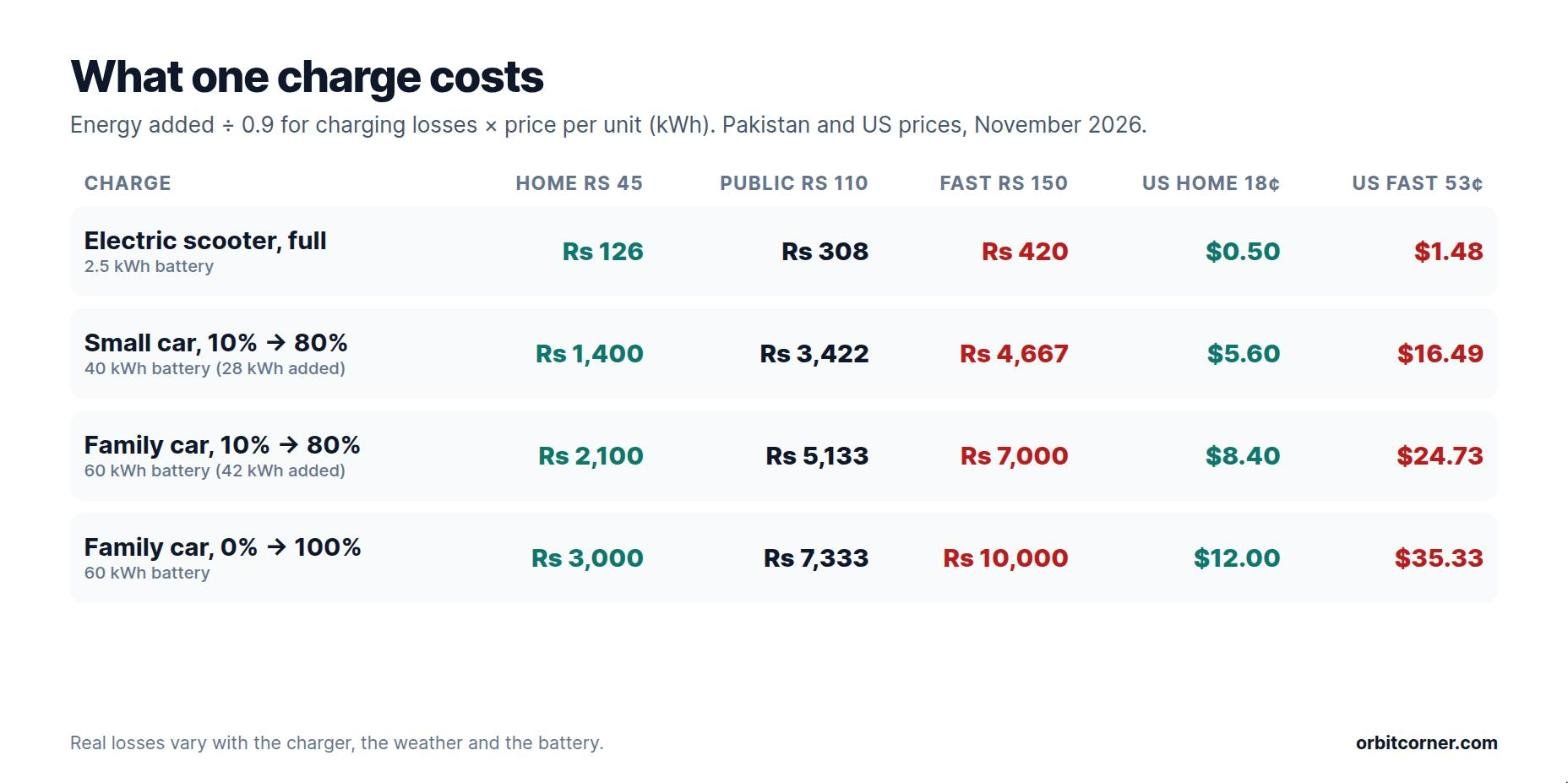
What one charge costs
| Charge | At home, Rs 45 | Fast charger, Rs 150 |
|---|---|---|
| Scooter, empty to full (2.52 kWh) | Rs 126 | Rs 420 |
| Small car, 10% to 80% (40 kWh) | Rs 1,400 | Rs 4,667 |
| Family car, 10% to 80% (60 kWh) | Rs 2,100 | Rs 7,000 |
| Family car, empty to full (60 kWh) | Rs 3,000 | Rs 10,000 |
The scooter row uses a 2.52 kWh battery, the size of the Evee S1 Air, which claims up to 100 km per charge. On paper that is about Rs 126 per 100 km at home.
Charging at home vs public chargers
Pakistan
At home you pay your normal tariff. Before tax, 2026 domestic rates run from about Rs 22 a unit for the first 100 units to about Rs 47 above 700 units; GST and monthly fuel adjustments come on top. We use Rs 45 a unit as a realistic all-in price for a home that adds an EV.
Public chargers are a different story. NEPRA sells electricity to charging stations at Rs 23.57 a unit, and the Power Division puts the cost at about Rs 39.70 a unit after taxes. But NEPRA lets each station set its own margin, and PakWheels reports that independent operators often charge Rs 110 to Rs 150 a unit.
United States
The EIA expects home electricity to average about 18¢ per kWh in 2026. Fast charging is far pricier: the charging data firm Paren put the average around 53¢ per kWh in early 2026, nearly three times the home rate.
What charging adds to your monthly bill
Work out your monthly units: km you drive in a month ÷ km per kWh. If your car’s official rating is in kWh per 100 km, it often already includes charging losses, so you can skip the 0.9 step.
| Monthly driving | Units added | At Rs 45 | At 18¢ |
|---|---|---|---|
| Electric scooter, 1,000 km (2.52 kWh per 100 km plus losses) | 28 | Rs 1,260 | $5.04 |
| Car, 1,000 km at 6 km per kWh | 167 | Rs 7,500 | $30.00 |
| Car, 1,500 km at 6 km per kWh | 250 | Rs 11,250 | $45.00 |
The slab trap in Pakistan
Pakistani homes pay by slab, so the units your EV adds can push the whole bill into a dearer bracket. Take a home that uses 250 units a month and adds an EV that uses another 250.
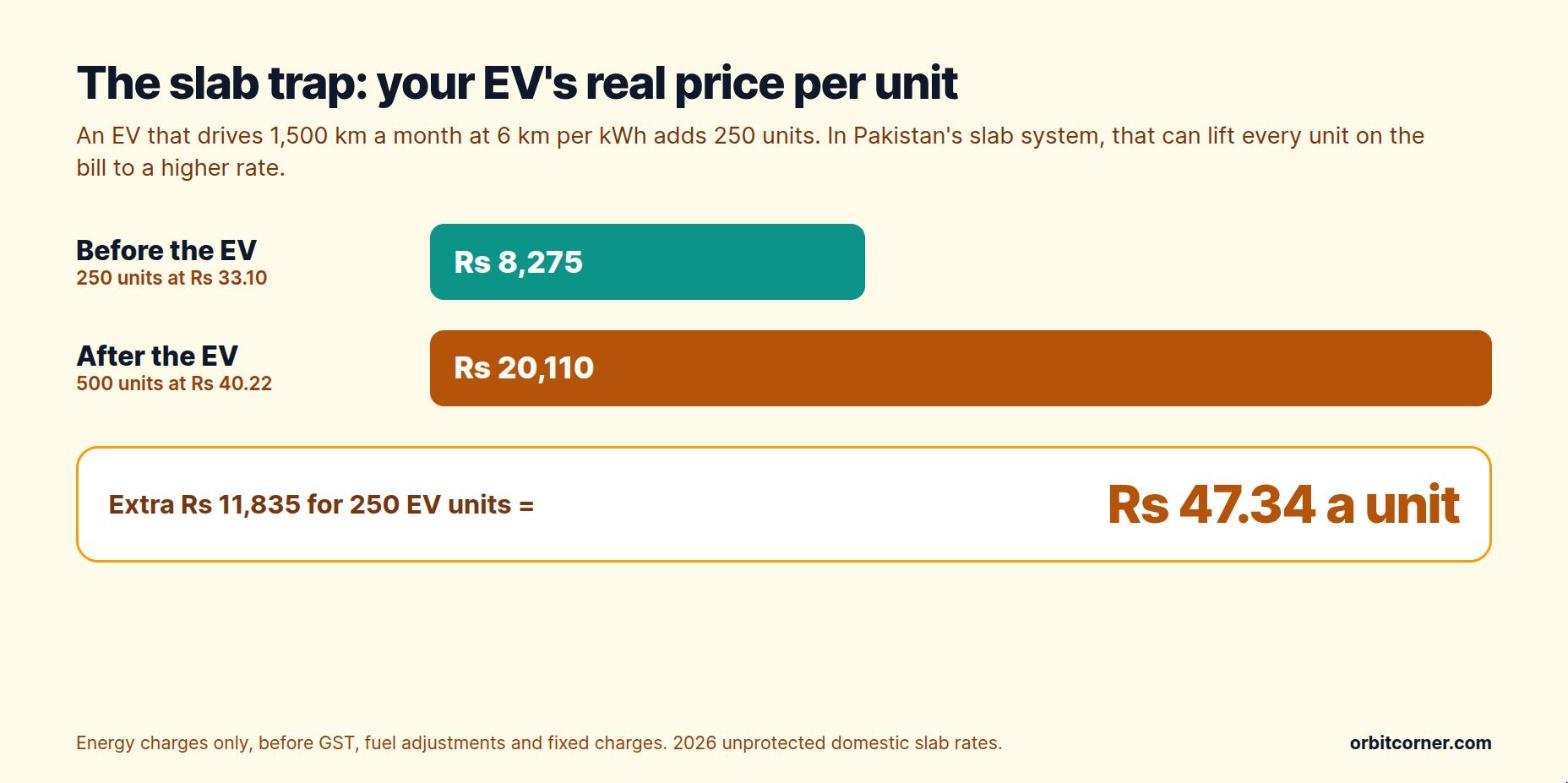
- Before the EV: 250 units in the 201–300 slab at Rs 33.10 = Rs 8,275.
- After the EV: 500 units in the 401–500 slab at Rs 40.22 = Rs 20,110.
- Real cost of the EV units: Rs 11,835 ÷ 250 = Rs 47.34 a unit, before GST and fixed charges.
This is a worst case where every unit on the bill moves to the higher slab rate. Check how your own bill applies slabs, and use your real cost per extra unit when you compare an EV with petrol.
How to cut your charging cost
- Charge at home whenever you can. It is the cheapest option almost everywhere.
- Use off-peak hours if you have a time-of-use meter. In Pakistan, homes with a sanctioned load of 5 kW or more pay by time of use; IESCO’s off-peak rate is Rs 34.53 against Rs 46.85 at peak, before tax.
- Save fast charging for long trips. At Rs 150 a unit, an EV can cost more per km than petrol.
- Charge in daylight if you have rooftop solar. Every unit your panels supply is one you don’t buy from the grid.
- Check the price before you plug in. Public charger prices vary by operator, so compare apps or price boards.
Is charging cheaper than petrol?
At home, by a wide margin. With petrol at Rs 335 a litre, a 14 km/L car costs Rs 23.93 per km, while an EV doing 6 km per kWh costs Rs 7.50 per km at Rs 45 a unit. Our guide to electric vs petrol running cost shows the full comparison, including the break-even electricity price at which petrol wins.
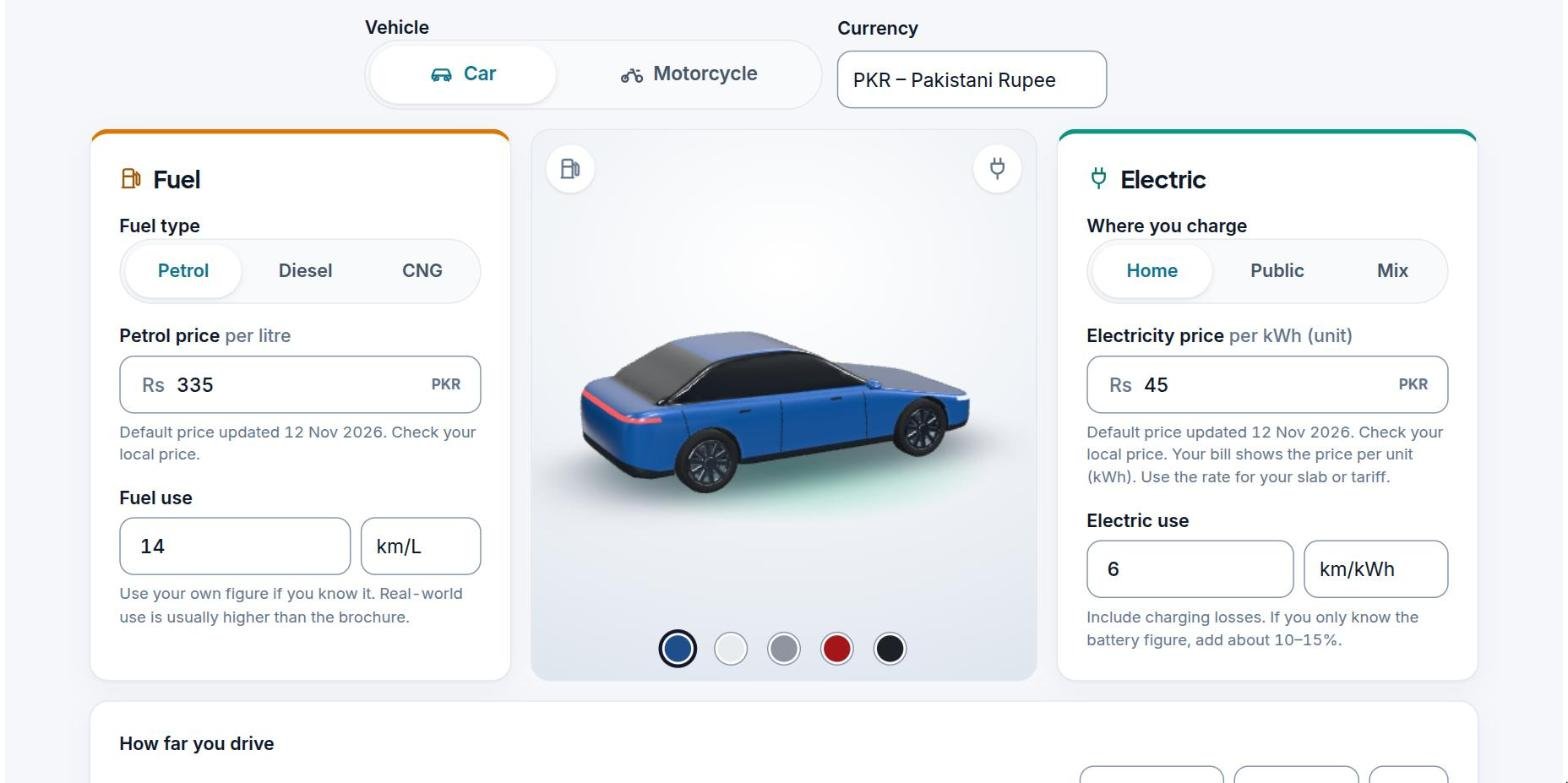
See your own charging cost
Enter your electricity price, how far you drive and your fuel price. Choose Home, Public or Mix charging.
Worried about the battery? See how long EV batteries last and what a replacement costs.
Frequently asked questions
How much does it cost to fully charge an electric car?
Battery size ÷ 0.9 × your price per unit. A 60 kWh battery from empty costs about Rs 3,000 at Rs 45 a unit, or about $12 at 18¢ per kWh.
How much does it cost to charge an electric scooter in Pakistan?
Very little. A 2.52 kWh battery costs about Rs 126 to fill at Rs 45 a unit, which is about Rs 1,260 a month for 1,000 km on paper.
Why is public charging so expensive?
Stations pay for the charger, the grid connection and the site, and they add a margin. In Pakistan NEPRA lets stations set their own margin, so prices of Rs 110 to Rs 150 a unit are common.
Does charging an EV raise my electricity bill a lot?
It adds units, so yes. A car driving 1,500 km a month adds about 250 units. In Pakistan, check whether those units push you into a higher slab, because that raises the rate you pay.
Is it cheaper to charge at night?
Only on a time-of-use tariff. In Pakistan, homes with a sanctioned load of 5 kW or more pay a lower off-peak rate. On a flat tariff, the time of day does not change the price.
Sources
- fueleconomy.gov: where the energy goes in electric cars (charging losses)
- US EIA: Short-Term Energy Outlook, electricity prices
- Electrek: US fast-charging prices in Q1 2026 (Paren report)
- Profit: NEPRA sets EV charging tariff at Rs 23.57 per unit plus margin
- Power Division: discounted tariff for EV charging stations
- PakWheels: public EV charging prices in Pakistan (2026)
- The Express Tribune: NEPRA domestic tariff slabs for 2026
- IESCO: tariff guide (time-of-use and EV charging station rates)
- TechJuice: Evee S1 Air battery and range
How we worked this out: every charge uses kWh added ÷ 0.9 × price per unit. Pakistani prices are from November 2026; check your own bill and the charger’s price before you plug in.