Overtime Pay Explained: How to Calculate Time-and-a-Half (With Examples)
You worked a long week and your payslip says “OT”. Is the number right? Overtime pay is simple once you know two things: when overtime starts where you work, and what rate applies.
This guide explains time-and-a-half in plain words, shows the rules in the US, California, the UK and Pakistan, and walks through real examples you can check against your own pay.
The short answer
- Time-and-a-half means 1.5 times your normal hourly rate. At $20 an hour, overtime is $30 an hour.
- Overtime pay = hourly rate × 1.5 × overtime hours.
- In the US, most hourly workers get overtime for hours over 40 in a workweek.
- Rules change by place: California also counts daily hours, the UK leaves the rate to your contract, and Pakistan’s labour laws set double pay.
How to calculate time-and-a-half, step by step
- Add up your hours for the week. Use actual hours worked, after unpaid meal breaks. (Our guide to calculating hours worked with lunch breaks shows how.)
- Split regular and overtime hours. Under the US federal rule, the first 40 hours are regular and anything above is overtime.
- Find your overtime rate. Multiply your hourly rate by 1.5. $20 × 1.5 = $30.
- Add the two parts. Regular hours × normal rate, plus overtime hours × overtime rate.
Worked example: a 45-hour week at $20 an hour
| Part | Calculation | Pay |
|---|---|---|
| Regular hours | 40 h × $20 | $800 |
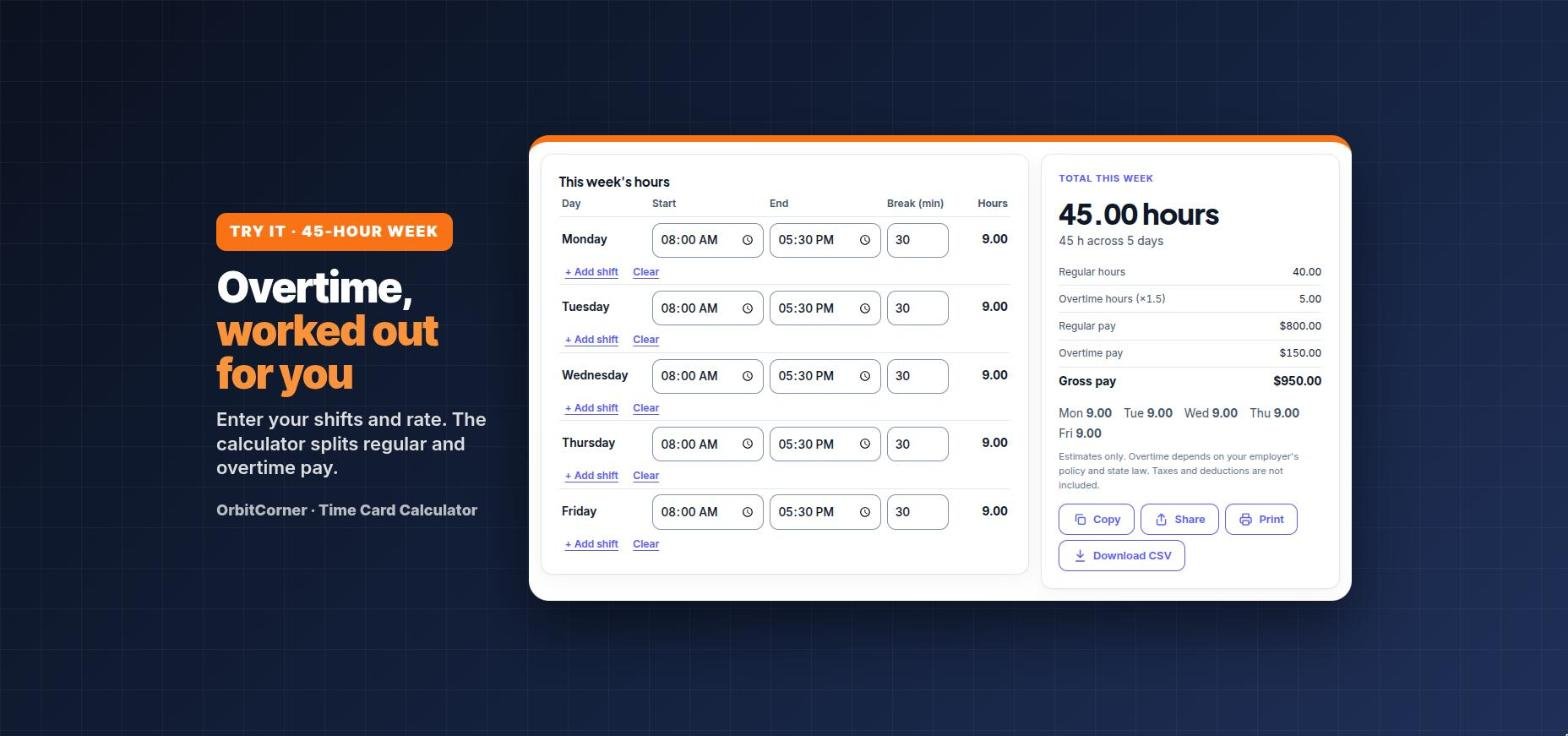
| Overtime hours | 5 h × $30 (1.5 × $20) | $150 |
| Gross pay | $950 |

Time-and-a-half and double time quick chart
| Normal rate | Time-and-a-half (1.5×) | Double time (2×) |
|---|---|---|
| $10 | $15 | $20 |
| $15 | $22.50 | $30 |
| $18 | $27 | $36 |
| $20 | $30 | $40 |
| $25 | $37.50 | $50 |
| $30 | $45 | $60 |
Overtime rules by country
United States (federal law)
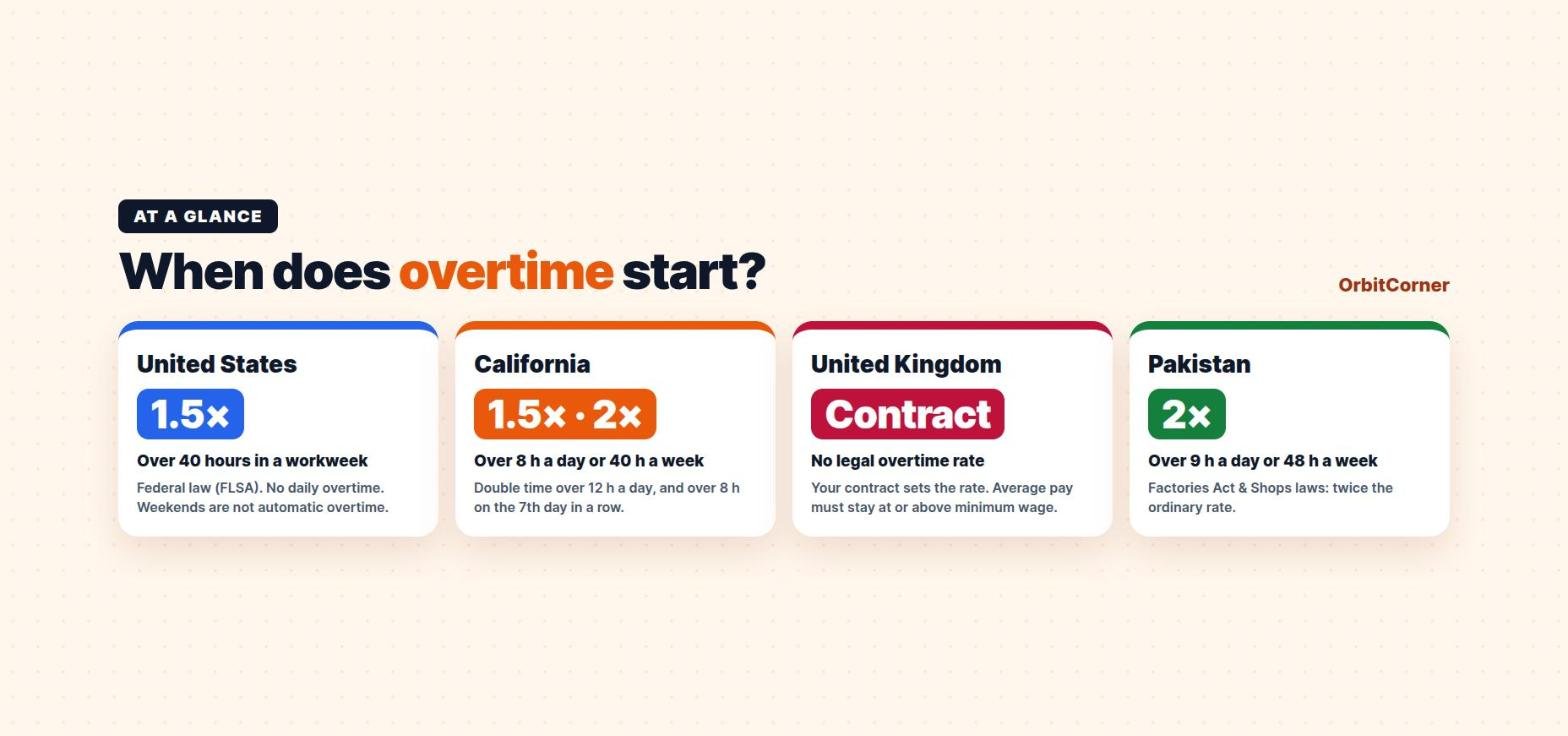
Under the Fair Labor Standards Act, covered non-exempt employees must get at least 1.5 times their regular rate for hours over 40 in a workweek. Federal law has no daily overtime, and working on a weekend or holiday is not automatically overtime. Each workweek stands alone: hours cannot be averaged across two weeks. Many states add their own rules on top.
California
California counts both daily and weekly hours. You get 1.5× for hours over 8 in a workday or over 40 in a week, and double time for hours over 12 in a day. On the 7th day in a row in one workweek, the first 8 hours are 1.5× and anything beyond 8 is double time.
That makes a big difference for long shifts. Four 10-hour days at $20 an hour is 40 hours, so federal law pays $800 with no overtime. In California, the 2 extra hours each day are overtime: 32 × $20 + 8 × $30 = $880.
United Kingdom
There is no legal right to a higher overtime rate in the UK. Your contract decides whether overtime is paid and at what rate, such as time-and-a-half or double time. What the law does require is that your average pay across all hours worked does not fall below the National Minimum Wage. Most workers also cannot be made to work more than an average of 48 hours a week unless they agree in writing.
Pakistan
Under the Factories Act 1934 and the Shops and Establishments laws, adult workers who work more than 9 hours in a day or 48 hours in a week are entitled to overtime at twice their ordinary rate of pay. Each province has its own version of these laws, so details can differ.
Example: with a monthly basic pay of Rs 52,000, one common way to find the hourly rate is Rs 52,000 ÷ 26 working days ÷ 8 hours = Rs 250 an hour. Overtime at double rate is Rs 500 an hour, so 10 hours of overtime is Rs 5,000. Check your contract, because employers and provincial laws may define “ordinary rate” differently.
This is general information, not legal or tax advice. Exempt employees, contractors and freelancers usually do not get legal overtime. If you think you are being underpaid, contact your employer, HR, or your local labour department.
Check your own week in seconds
Our time card calculator works out your daily hours, takes off breaks and splits regular and overtime pay automatically. You can switch between the US weekly rule, a daily rule and California rules, and set your own overtime multiplier.
Calculate your overtime now
Enter your shifts and hourly rate to see regular pay, overtime pay and your weekly total. Print it or download it as a CSV.
Common overtime mistakes
- Thinking weekends are always overtime. Under US federal law, they only count if your weekly total goes over 40.
- Averaging two weeks. 50 hours one week and 30 the next is still 10 hours of overtime in the first week.
- Assuming “salaried” means no overtime. In the US, being exempt depends on your salary level and your job duties, not just on being paid a salary.
- Leaving bonuses out of the rate. Some bonuses must be included in your regular rate before working out US overtime.
- Writing minutes as decimals. 5 hours 30 minutes of overtime is 5.5 hours, not 5.3.
Quick answers
What is time-and-a-half?
It is 1.5 times your normal hourly rate. At $20 an hour, time-and-a-half is $30 an hour.
How do I calculate overtime pay?
Multiply your hourly rate by 1.5, then multiply by your overtime hours. Add that to your regular pay for the first 40 hours.
Is overtime after 8 hours a day?
Not under US federal law, which only counts hours over 40 in a week. Some states, like California, also pay overtime after 8 hours in a day.
What is the overtime rate in Pakistan?
Under the Factories Act and Shops laws, work beyond 9 hours a day or 48 hours a week is paid at twice the ordinary rate.
Sources: US Department of Labor, Fact Sheet #23; California Department of Industrial Relations: overtime; GOV.UK: overtime, your rights; Pakistan Factories Act 1934, section 47, as summarised by WageIndicator Pakistan.