Client Won’t Pay Your Invoice? What to Do, Day by Day
Short answer: send a polite reminder the day after the due date, a firmer one at day 7 with a phone call, and pause any new work by day 14. At day 30, send a final notice that names a deadline and the interest you are entitled to. If that fails, choose between a payment plan, your country’s small-claims or statutory route, or a collection agency, based on how much is owed. Most late invoices are paid at the reminder stage, so start early and stay calm and specific.
An unpaid invoice feels personal, but most late payments come down to process: the invoice went to the wrong inbox, it is stuck waiting for approval, or the client is short on cash this month. Deliberate non-payment does happen, which is why you need a plan that starts friendly and gets firmer on a fixed schedule.
This guide gives you that plan: what to do on each day after the due date, five emails you can copy, the legal options in the US, UK, EU and India with worked interest examples, and the invoice and contract terms that stop it happening next time.
This is general information, not legal advice. Rules change and depend on your contract and where you and your client are based. For large amounts, talk to a local lawyer or your trade association before going to court.
First, rule out a simple mix-up
Before you chase, spend five minutes checking the boring causes. They explain a surprising share of late payments, and fixing them keeps the relationship intact.
- Did they actually receive it? Check the address you sent it to. Accounts teams often need invoices sent to a separate billing email, not your day-to-day contact.
- Is anything missing? Many companies cannot pay an invoice without a purchase order (PO) number, their legal company name, a tax ID or your bank details in the right format.
- Did the work pass their approval step? Some clients only pay once the project lead signs off. Ask who that is.
- Is it really overdue? “Net 30” means 30 days from the invoice date, not from when you finished the work.
If anything was missing, send a corrected invoice with the same number and a short note, and restart your clock from today.
The day-by-day plan for chasing an unpaid invoice
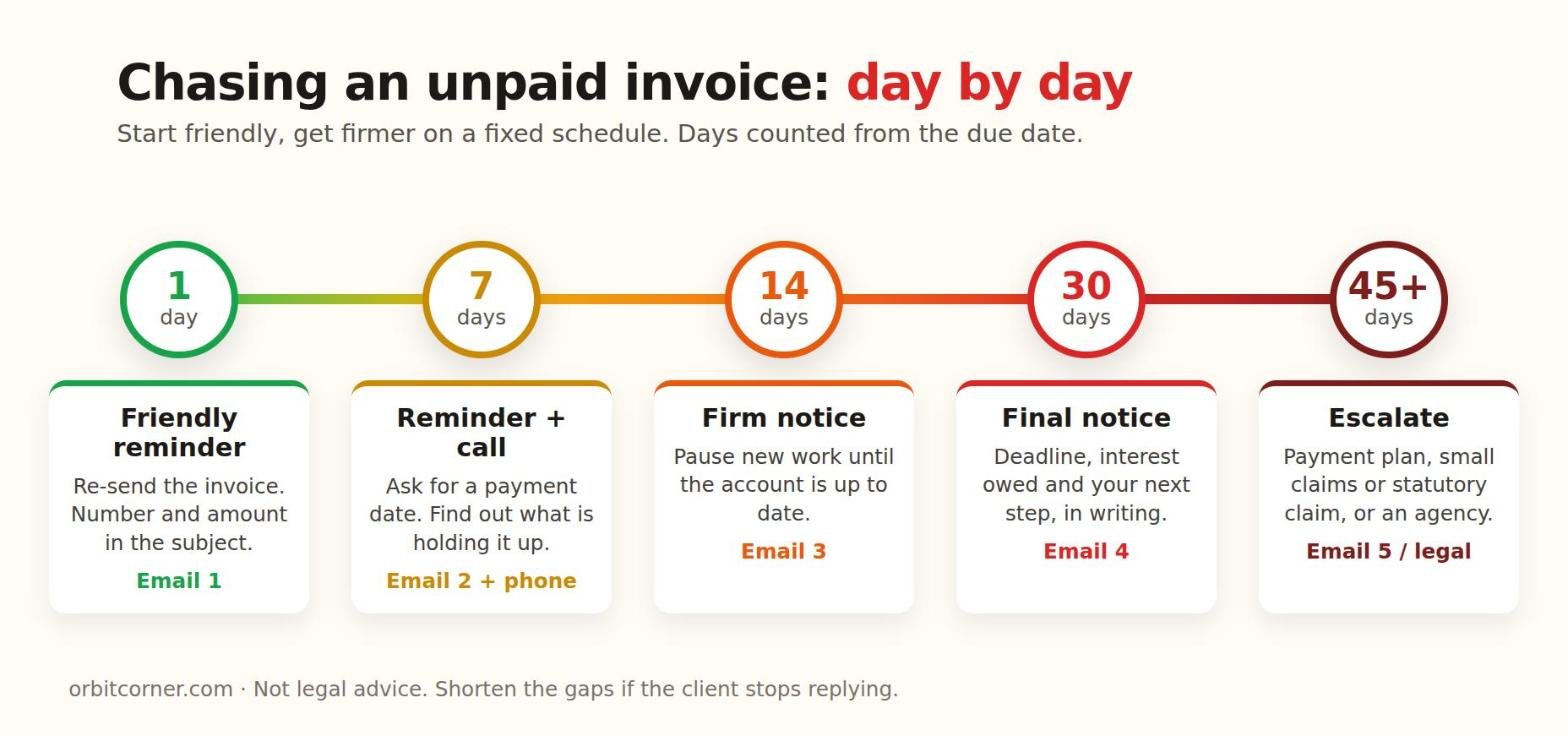
| When | What to do | Tone |
|---|---|---|
| Day 1 after the due date | Friendly reminder email with the invoice attached (Email 1) | Assume it was missed |
| Day 7 | Second reminder (Email 2) and a short phone call | Polite, specific |
| Day 14 | Firm notice (Email 3). Pause new work until the account is up to date | Professional, firm |
| Day 30 | Final notice with a payment deadline and interest (Email 4) | Formal |
| Day 45–60 | Escalate: payment plan, statutory or small-claims route, or a collection agency | Formal, in writing |
Day 1: the friendly reminder
Keep the first reminder short and attach the invoice again, so they can pay without searching their inbox. Put the invoice number and amount in the subject line; accounts teams search by both.
Subject: Invoice #1045 for $2,400 was due yesterday

Hi Sam,

A quick reminder that invoice #1045 for $2,400 was due on 14 November. I've attached it again in case it got lost.

You can pay by bank transfer to the details on the invoice, or reply and I'll send a card payment link.

Thanks,
Alex
Day 7: second reminder and a phone call
A week late, ask a direct question that needs an answer. Then call. A two-minute phone call gets more done than three more emails, because you find out whether the problem is approval, cash flow or a dispute.
Subject: Invoice #1045 is now 7 days overdue

Hi Sam,

Following up on invoice #1045 for $2,400, which is now 7 days overdue.

Could you let me know when it's scheduled for payment? If anything is holding it up, such as a missing PO number or approval, tell me and I'll sort it out today.

Thanks,
Alex
Phone script: “Hi Sam, I’m calling about invoice 1045, which was due on the 14th of November. It’s a week overdue and I wanted to check whether anything is holding it up on your side. When can I expect payment?” Then stop talking and note the date they give you.
Day 14: the firm notice and pausing work
Two weeks late is the point to stop doing new work for this client. Continuing to deliver removes their main reason to pay. Say so plainly, without threats.
Subject: Overdue: invoice #1045, 14 days late

Hi Sam,

Invoice #1045 for $2,400 is now 14 days overdue, and I haven't had a payment date yet.

Under our agreement, I'll pause work on the next phase until the account is up to date. I'd like to keep the project moving, so please arrange payment or reply with a firm date by Friday, 4 December.

Regards,
Alex
Day 30: the final notice
The final notice is the last step before formal action, so make it complete: the amount, the original due date, a payment deadline (seven days is common), any interest or fees you are entitled to, and what you will do next. In the UK this kind of letter is often called a “letter before action”.
Subject: Final notice: invoice #1045 ($2,400), 30 days overdue

Dear Sam,

Invoice #1045 for $2,400, due on 14 November, remains unpaid despite reminders on 15 November, 21 November and 28 November.

Please pay the full amount by 21 December. From the due date, late-payment interest of [rate] applies under [our contract / the relevant law], currently [amount].

If payment is not received by that date, I will begin [small claims proceedings / a statutory claim / referral to a collection agency] without further notice.

Regards,
Alex Morgan
[Business name and address]
Only name an action you are actually prepared to take. Empty threats teach clients to ignore your deadlines.
If they say they can’t pay: offer a payment plan
A client who answers “we’re short on cash” is worth more than one who goes silent. Offering a short written payment plan often recovers the money faster than any legal route.
Subject: Payment plan for invoice #1045

Hi Sam,

Thanks for being upfront. I can split the $2,400 into three payments:

- $800 by 7 December
- $800 by 21 December
- $800 by 4 January

If any payment is more than 7 days late, the full remaining balance becomes due immediately. Please reply to confirm and I'll send a revised invoice.

Thanks,
Alex
Your legal options, country by country
If reminders fail, the next step depends on where your client is based. The rules below cover business-to-business invoices; consumers usually have extra protections.
United States
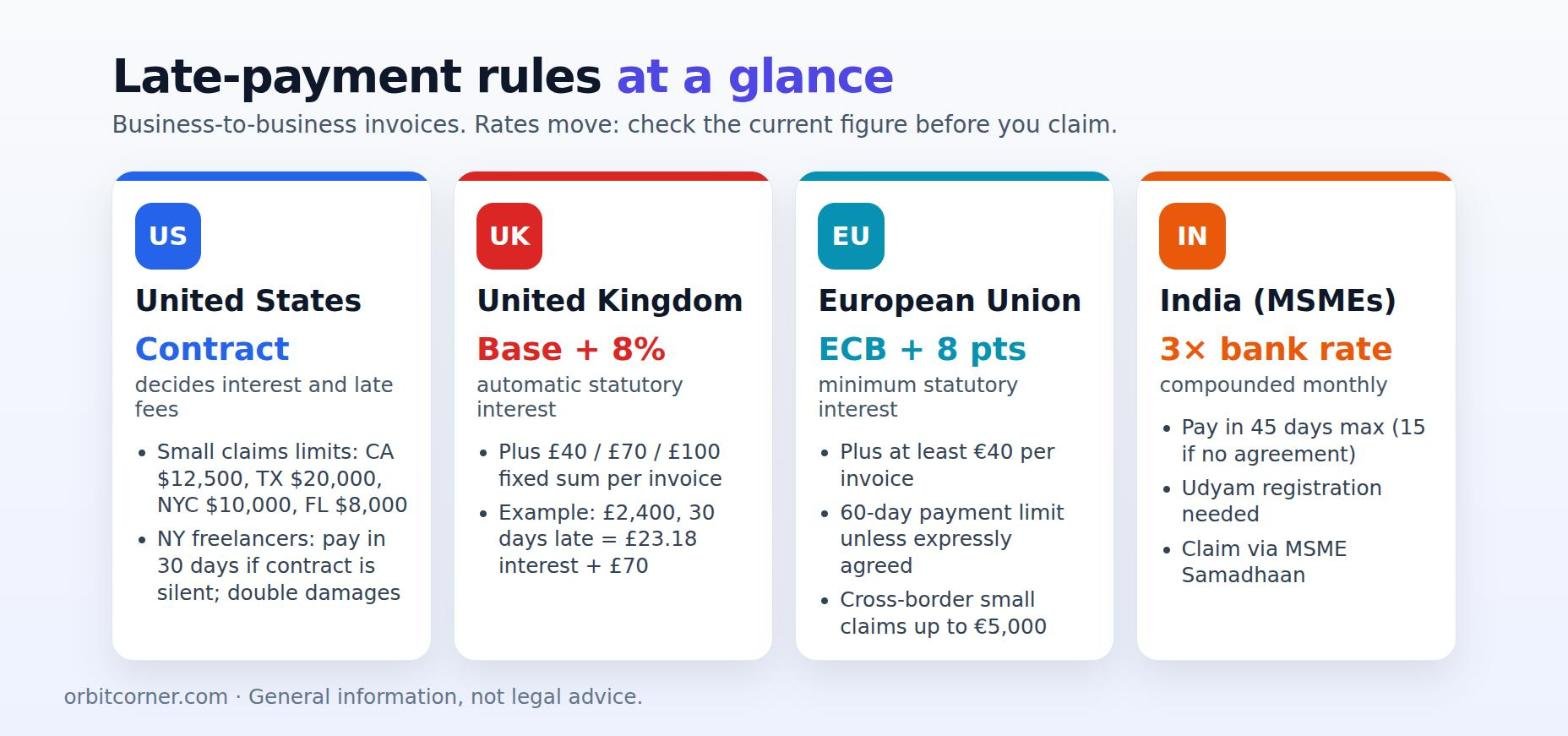
There is no single federal late-payment law for private invoices, so your contract and invoice terms decide whether you can charge interest or late fees. If they say nothing, you can usually still sue for the amount owed. State laws cap how much interest you can charge, so keep any late fee modest and agreed in writing.
Small claims court is the usual route for smaller debts. You don’t need a lawyer, filing fees are low, and hearings are quick. Each state sets its own maximum:
| State | Small claims limit (2026) |
|---|---|
| California | $12,500 for individuals, $6,250 for businesses |
| Texas | $20,000 |
| New York | $10,000 in New York City courts (lower elsewhere in the state) |
| Florida | $8,000 |
| Illinois | $10,000 |
Freelancers in New York have extra protection under the Freelance Isn’t Free Act. Hiring parties must pay by the date in the contract, or within 30 days of the work being finished if the contract says nothing, and a freelancer who wins a non-payment claim can recover double damages and legal fees. The law applies statewide since August 2024, alongside the New York City version from 2017.
Winning a judgment does not guarantee payment. Before suing, ask whether the client has a real business and assets you could collect from.
United Kingdom
For business-to-business invoices, the Late Payment of Commercial Debts (Interest) Act 1998 gives you an automatic right to statutory interest at 8% above the Bank of England base rate, even if your contract and invoice say nothing about it. With the base rate at 3.75%, that is 11.75% a year.
You can also add a fixed sum for recovery costs to each overdue invoice: £40 for debts under £1,000, £70 from £1,000 to £9,999.99, and £100 for £10,000 or more.
Worked example: a £2,400 invoice paid 30 days late. Interest is £2,400 × 11.75% × 30 ÷ 365 = £23.18 (about £0.77 a day). Add the £70 fixed sum and you can claim £2,493.18 in total.
If the final notice fails, in England and Wales claims up to £10,000 usually go through the small claims track, and you can start one online with Money Claim Online.
European Union
Every EU country has implemented the Late Payment Directive (2011/7/EU). For business-to-business invoices it gives you an automatic right to interest of at least 8 percentage points above the European Central Bank reference rate, plus a minimum €40 per invoice for recovery costs. Unless both sides expressly agree otherwise, businesses should pay within 60 days.
The exact rate varies slightly by country, because each country publishes its own figure every six months. The Your Europe business portal lists the current rate for each country and includes a calculator. For cross-border claims under €5,000, the European Small Claims Procedure lets you sue a client in another EU country using a standard form.
India
If you are a micro or small enterprise registered on Udyam, the MSMED Act 2006 protects you. Buyers must pay by the agreed date, and no later than 45 days after accepting the work (or 15 days if there is no written agreement). After that, they owe compound interest with monthly rests at three times the RBI bank rate.
Worked example: at a bank rate of 5.50%, the MSMED rate is 16.5% a year, or 1.375% a month compounded. On an unpaid ₹2,00,000 invoice, three months of delay adds about ₹8,364. Check the current bank rate before you claim.
You can file the claim online through the MSME Samadhaan portal, which refers it to your state’s Micro and Small Enterprises Facilitation Council. Put your Udyam number and a line about MSMED Act interest on every invoice; it prompts many buyers to pay on time.
Other countries and international clients
Outside these regions, the rules depend on local law and, above all, on your contract. With clients in other countries, chasing through the courts is usually slow and expensive. Practical protection matters more:
- Take a deposit before you start, and bill in milestones so you are never owed much at once.
- Agree in the contract which country’s law applies and how disputes are handled.
- For platform work (Upwork, Fiverr and similar), use the platform’s escrow and dispute process. Working outside it usually means losing that protection.
- Keep everything in writing: the brief, approvals, delivery confirmations and every reminder.
Is it worth pursuing? A quick check
| Amount owed | Usually worth it | Usually not worth it |
|---|---|---|
| Small (a few hundred) | Reminders, a phone call, a payment plan | Lawyers or collection agencies, whose fees can exceed the debt |
| Medium | Final notice, then small claims or the statutory route in your country | Full court litigation |
| Large | A lawyer’s demand letter, then court or arbitration | Waiting months without escalating |
Also weigh the relationship. A long-standing client who pays late once deserves a call, not a court form. A client who pays late every time is costing you more than they are worth.
How to stop it happening again
The cheapest way to collect an unpaid invoice is to make it unlikely in the first place.
- Take a deposit. 30% to 50% upfront is normal for new clients. If a client refuses a reasonable deposit, treat it as a warning sign.
- Bill in milestones. For longer projects, invoice at each stage so you are never more than one stage unpaid.
- Put clear terms on every invoice: a due date (not just “Net 30”), the late-payment interest or fee you charge, and how to pay.
- Invoice immediately when work is delivered, while the value is fresh in the client’s mind.
- Ask for the billing contact and PO number at the start of the project, not at the end.
- Transfer ownership on payment. State in your contract that the client owns the final files or code once the invoice is paid in full.
- Make paying easy. Bank details, a card payment link or a QR code on the invoice remove excuses.
Example wording for your invoice terms:
Payment due within 14 days of the invoice date (by 28 November 2026).
Late payments are subject to interest at [X]% per month [or: statutory interest under the Late Payment of Commercial Debts (Interest) Act 1998].
Ownership of the final deliverables passes to the client on payment in full.
Make invoices that get paid on time
Our free invoice generator adds a deposit, payment terms, due date, your bank details and a payment QR code to a professional PDF. No sign-up, and nothing is uploaded.
New to invoicing? Our guide on how to make an invoice covers the ten details every invoice needs.
Frequently asked questions
How long should I wait before chasing an unpaid invoice?
Send a friendly reminder the day after the due date. Waiting a few weeks “to be polite” only signals that late payment is acceptable, and the longer an invoice is overdue the less likely it is to be paid.
Can I charge a late fee if it wasn’t in my contract?
In the UK and the EU, statutory interest and the fixed recovery sum apply to business-to-business invoices even if your contract is silent. In the US it usually depends on what was agreed in writing, so add a late-payment clause to future contracts and invoices.
Should I stop working for a client who hasn’t paid?
Usually yes, once an invoice is around two weeks overdue and you have no firm payment date. Tell the client in writing that work is paused until the account is up to date, so it doesn’t look like you abandoned the project.
Can I keep the files or website until they pay?
If your contract says ownership passes on payment, you can usually withhold final files that haven’t been delivered. Taking down work that is already live can breach your agreement, so check your contract or get advice first.
What if the client disputes the quality of the work?
Ask exactly what they think is wrong, in writing, and compare it with the agreed brief. Offer to fix genuine issues, and ask them to pay the undisputed part of the invoice in the meantime.
Can I post about a non-paying client online?
Be careful. Public accusations can expose you to defamation claims. Stick to formal channels, and only share factual information in private professional communities if at all.
Sources
- GOV.UK: Late commercial payments, charging interest and debt recovery
- legislation.gov.uk: Late Payment of Commercial Debts (Interest) Act 1998, section 5A (fixed sums)
- European Commission: Late payment directive
- Your Europe: Late payments, interest rates by country
- Bond, Schoeneck & King: New York statewide Freelance Isn’t Free Act
- Small claims court limits by state, 2026, with statute references
- Government of India: MSME Samadhaan delayed payment portal
- MSMED Act sections 15 to 19 and the current bank-rate calculation
