Smog Season: What Your AQI Number Means and How to Protect Your Family
If your phone’s weather app has turned purple or maroon this week, you’re not imagining the haze. In early November 2026, Lahore was again ranked among the most polluted cities in the world, with readings reported above 500 on the AQI scale. Punjab’s own monitors showed Gujranwala at 500 and Lahore at 478 on November 1. Delhi and much of north India go through the same thing every winter, and wildfire smoke brings similar numbers to North America, Australia and Europe in summer.
This guide explains what the AQI number actually means, who needs to be most careful, which masks work, and how to make one room in your home a safe place to breathe. It works for any city and any season, so bookmark it for the next bad-air day.
Short answer: Check the AQI every morning. Above 150, everyone should cut down on time outdoors. Above 200, stay indoors as much as you can. Above 300, avoid all outdoor exercise. When you must go out, wear a well-fitted N95 or KN95 (not a cloth or loose surgical mask). At home, keep windows shut and run a HEPA air purifier in the room where you sleep.
What the AQI number means
AQI stands for Air Quality Index. Most apps (IQAir, Google, Apple Weather, AirNow) use the US EPA scale, which runs from 0 to 500. The main pollutant behind smog is PM2.5: particles so small they get deep into your lungs and even your bloodstream. The higher the number, the more of them are in the air.
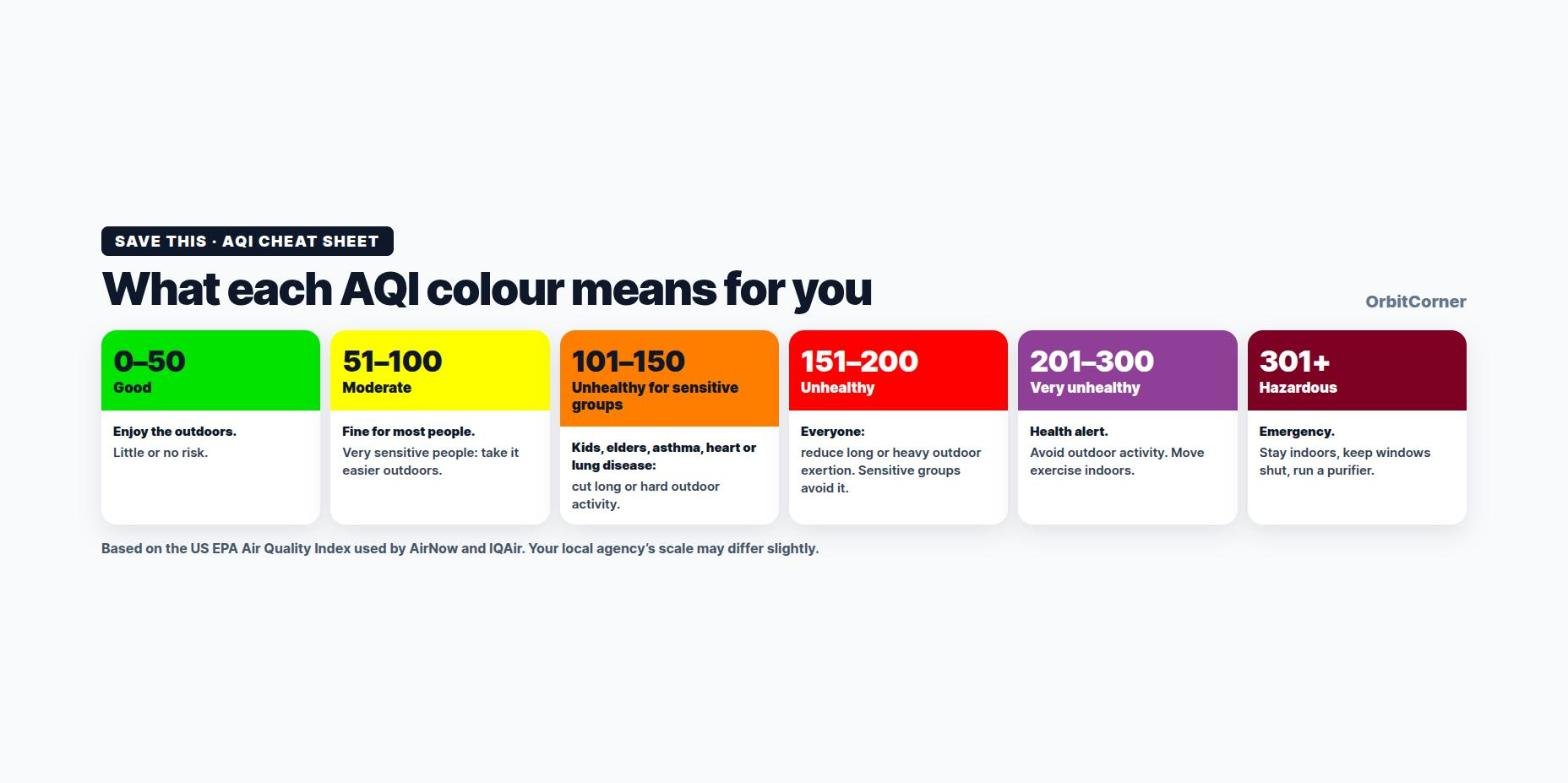
| AQI | Level | What to do |
|---|---|---|
| 0–50 | 🟢 Good | Normal day. Open the windows and enjoy it. |
| 51–100 | 🟡 Moderate | Fine for most people. If you are unusually sensitive, take it easy outdoors. |
| 101–150 | 🟠 Unhealthy for sensitive groups | Children, older adults, pregnant people and anyone with asthma, heart or lung disease should reduce long or heavy outdoor activity. |
| 151–200 | 🔴 Unhealthy | Everyone should cut back on outdoor exertion. Sensitive groups should avoid it. |
| 201–300 | 🟣 Very unhealthy | Stay indoors as much as possible. Move exercise inside. Mask up if you go out. |
| 301–500 | 🟤 Hazardous | Everyone should avoid all outdoor physical activity. Keep windows closed and run a purifier. |
One tip: look at the hourly forecast, not just the current number. Smog is often worst late at night and early in the morning, when cold air traps it near the ground, and it can ease a little in the afternoon. If you need to run errands, that is usually the better window.
Who needs to be most careful
- Children. They breathe faster than adults and their lungs are still developing. Skip outdoor play and sports on very unhealthy days.
- Older adults. Smog raises the strain on the heart and lungs.
- Pregnant people. Limit exposure, and ask your doctor if you have concerns.
- Anyone with asthma, COPD or heart disease. Keep your inhaler and medicines close, follow your action plan, and talk to your doctor before smog season if you can.
- Outdoor workers. Delivery riders, traffic police, construction workers and street vendors get the most exposure. A properly fitted N95 makes the biggest difference for this group.
Which mask actually works against smog
Not all masks are equal. The tiny PM2.5 particles in smog slip straight past fabric and through gaps at the edges.
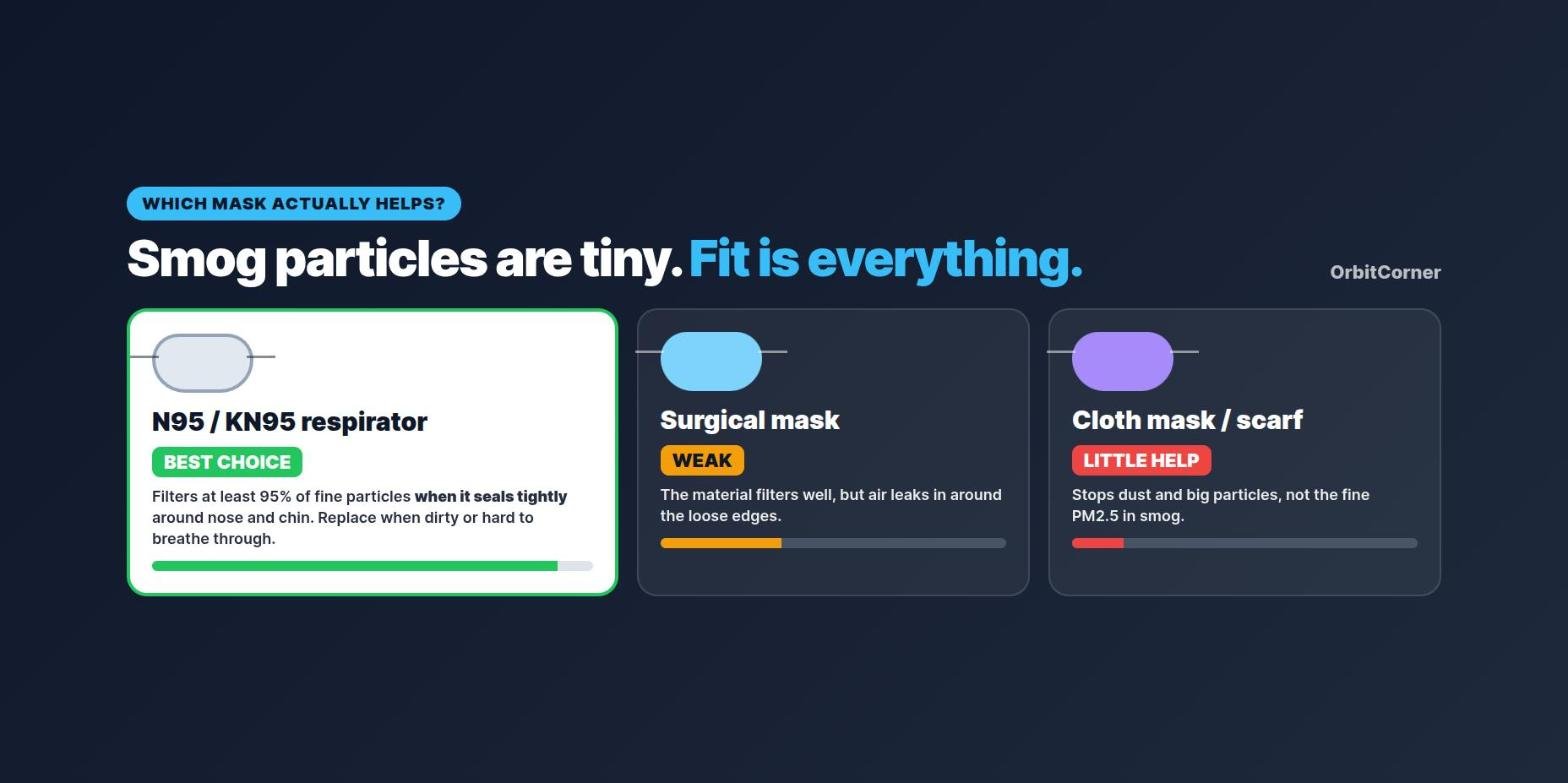
- N95 / KN95 / FFP2: Filter at least 95% of fine particles, but only when sealed tightly to your face. Pinch the nose clip, and check that air doesn’t leak around the edges when you breathe out. A beard stops it from sealing.
- Surgical masks: Better than nothing, but they sit loosely, so a lot of air goes around the sides instead of through the mask.
- Cloth masks and scarves: Offer little protection against smoke and smog particles.
Good to know: Adult N95s often don’t seal on small children’s faces, so for kids, staying indoors is the better protection. People with heart or lung disease should ask a doctor before wearing an N95 for long periods, since it takes more effort to breathe through. Replace a mask when it gets dirty, damp or hard to breathe through.
Make one clean-air room at home
You don’t need to purify your whole house. The simplest, cheapest move is to pick one room, usually the bedroom where you spend 7 to 9 hours a night, and keep that air as clean as possible.
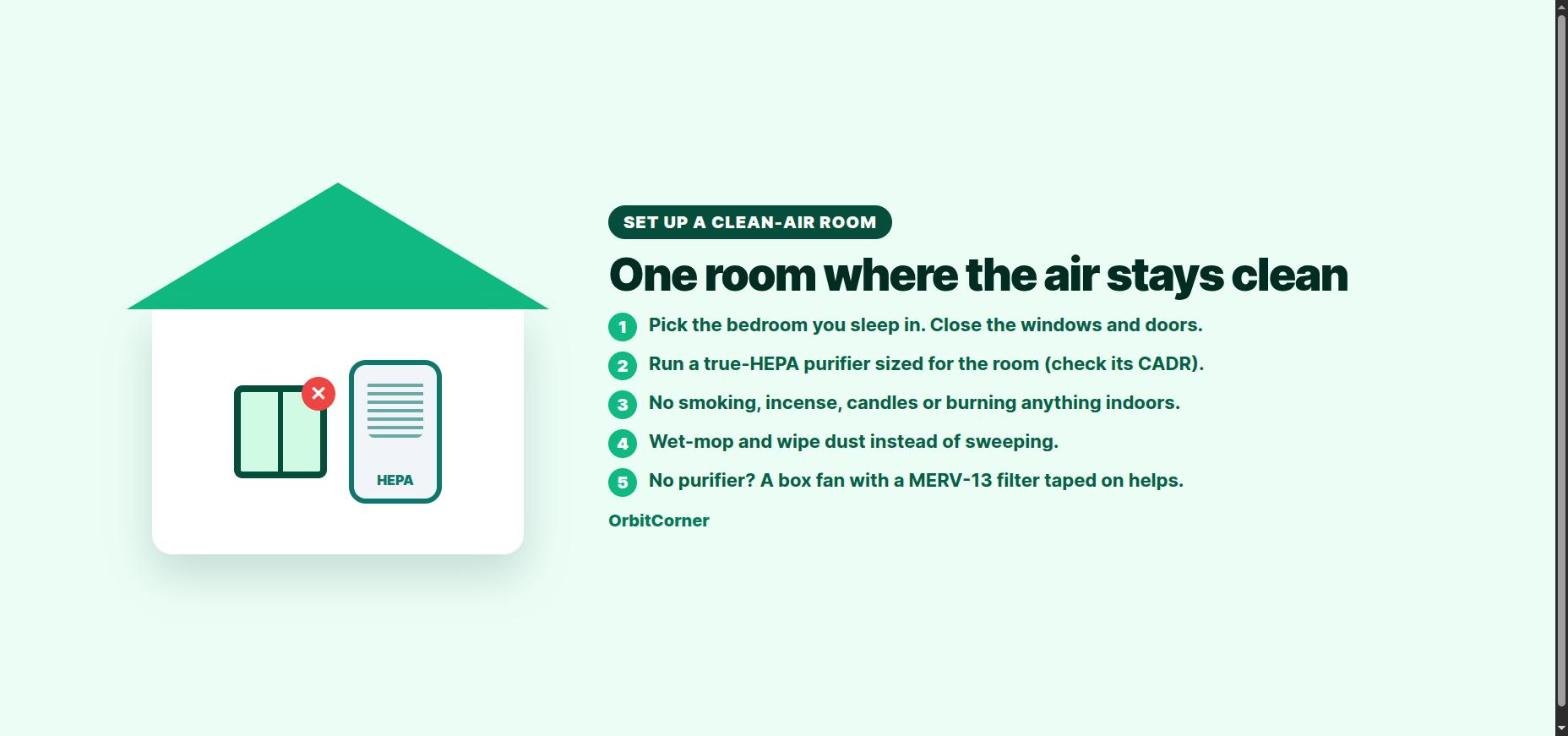
- Close it up. Shut windows and doors. Seal obvious gaps under doors with a rolled towel.
- Run a true-HEPA purifier. True HEPA filters capture 99.97% of particles at 0.3 microns. Choose one sized for your room by its CADR (clean air delivery rate): the higher the CADR, the bigger the room it can clean. Run it on high when the AQI is bad and keep the door closed.
- Don’t add smoke indoors. No smoking, incense, candles, or burning wood or coal. Avoid frying with lots of smoke on the worst days.
- Clean without stirring dust. Wet-mop floors and wipe surfaces with a damp cloth instead of sweeping.
- No purifier? Build one. A box fan with a MERV-13 furnace filter taped to the back is a widely used low-cost option recommended by the US EPA during wildfire smoke. Make sure the airflow arrow on the filter points toward the fan, and never leave it running unattended.
Daily habits that cut your exposure
- Check the AQI each morning before planning walks, school runs or exercise.
- Move workouts indoors on red, purple and maroon days. Heavy breathing pulls in far more particles.
- In the car, keep the windows up and set the AC to recirculate.
- Avoid busy roads when walking. Pollution is highest right next to traffic.
- Drink water and eat well. It won’t filter the air, but it helps with dry throat and irritated eyes.
- Follow local announcements. In Punjab, school timings, office rules and other smog measures can change at short notice, so check the latest updates from the Punjab Environment Protection Department and PDMA.
When to get medical help
Itchy eyes, a scratchy throat and a mild cough are common on smoggy days and usually ease once you’re in cleaner air. Get medical help quickly if you or a family member has trouble breathing, wheezing that doesn’t settle with an inhaler, chest pain or tightness, a racing heartbeat, or feels dizzy or confused. For a child, fast or labored breathing is a reason to see a doctor.
Note: This guide is general information, not medical advice. If you have a health condition, follow your doctor’s advice.
Quick answers
Is it safe to open windows during smog?
Not when the outdoor AQI is high. Open them briefly when the outdoor number drops, for example on a windy afternoon or after rain.
Can I go for a walk if the AQI is 200?
A short, easy walk is lower risk than a run, but sensitive groups should avoid it, and everyone should keep it brief. Indoors is better.
Does a plant or an ionizer clean the air?
Houseplants don’t remove meaningful amounts of PM2.5 in a home. Avoid ozone-producing “ionizer” purifiers. A true-HEPA purifier is what works.
Why are different apps showing different AQI numbers?
They use different sensors and sometimes different scales (Pakistan, India and China each have their own national index). Pick one app and follow its trend.
Stuck indoors? Plan your days better
Working from home on a smog day? Use our free time and pay tools to track your hours and plan your week.
Sources
- AirNow (US EPA): AQI Basics
- US EPA: Air Cleaners and Air Filters in the Home
- CDC: Wildfire smoke and health
- Daily Pakistan and ARY News reporting on Punjab air quality, November 2026